Showing posts with label GWR. Show all posts

Saturday, 5 June 2021

Hall Chassis Progress

 The final job on the body, before turning to the chassis, was the cab roof.


The first job on the chassis was the bogie. I was off to a flying start with a spare P4 part from a Martin Finney kit: Part 18, the fold-up etching for the basic frame. The remaining dozen parts used measurements of the Finney frame to supplement the few bogie measurements I did have. I incorporated my usual style of side control springing acting at axle level on the 3/32" brass tube mounting pillar.


Toynbee Hall now has a chassis with spacers temporarily soldered one side only, loosely assembled with jig axles, a trial cylinder assembly from a set of  Kemilway parts I bought in 1985 through the Scalefour Society, and a painted bogie with jury axles. I made up a cross-frame slidebar bracket from spare Finney Parts 39 laminated around a central core at the appropriate spacing. And to help with the illusion, I fettled the smokebox door rescued from my old Triang Albert Hall bought in 1967/8, added a nickel door dart and a front number plate for 5961.

Sunday, 11 April 2021

Hall Boiler Progress

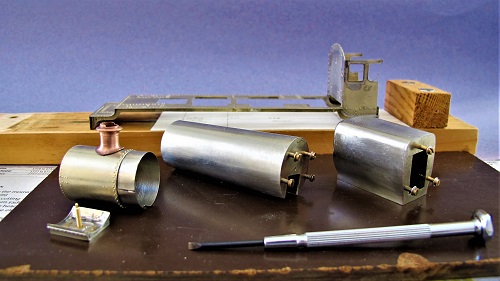
At long last I sourced a sheet of 8 thou nickel silver (thanks for the recommendation, Frank) allowing me to continue with Toynbee Hall’s taper boiler – see post of 4th October, 2020. I also found it so much easier to in-fill the cut-out in the cab front rather than make a new item, and the Finney chimney certainly helps the look of the model.

The boiler and firebox bolt together, and the boiler is a push fit onto the extended smokebox inner. The complete boiler unit sits on the saddle at one end, bolted to the smokebox, and is bolted to the cab front at the other end. I finished this stage of the work by preparing a nickel blank for the cab roof, then put the project to one side to take a break.


Friday, 3 April 2020

St Donats 1963 Re-start


Since the last post in April 2019 I have struggled to get back into modelling, the last work on the diorama finishing around February 2019. I did have a flurry of activity upgrading 1649 at the Missenden Summer School in 2019 and continued until October. Compare this photo with the one in the post of 1st February 2019. It’s strange to think how I was happy to exhibit 1649 on Kyle of Sutherland in that form and that no-one commented on the lack of detail.


The detailing and the above view of 1649 were based on a photo of 1643 on the cover of Roger Cox’s copy of “The Pannier 16xx”, a double page spread of 1643 inside, and photographs of every 16xx for cross-referencing. My shed books tell me 1643 was a Llanelly engine, which I saw in 1963, so it wouldn’t be too much of a stretch to re-number 1649 to1643 for use on St Donats 1963. My thanks go to Roger for an extensive loan, the book being now safely back in his hands again.

Of particular note are the sandboxes folded up from 6 thou nickel as in Photo H9, page 94, of Guy Williams “The 4mm Engine, A Scratchbuilder’s Guide”, and the water balance pipe made from a 5 thou brass fold-up over a hard brass core, just visible behind the middle splasher. The snagging list still contains over 20 items, including a new front lamp with improved carrying handle.

But what of the diorama itself? My self-isolation to reduce the risk of catching the corona virus has brought about a resurgence of interest and enthusiasm in modelling. Here a health expert keeps me company while I review plans for the main structure, aka the “box”.


With the experience of making Kyle of Sutherland under my belt, I decided this time to make the box first, rather than the layout, and avoid the difficulty of boxing up the completed layout later when I needed to store it.


Now, with the top and front panels removed, the base of the box will be revealed as a traditional baseboard (salvaged from Kyle of Sutherland and reduced in size) with the box sides and back panel able to support the proscenium arch, backscene and lighting.


Friday, 1 February 2019

Starting The Layout


Cannibalising an earlier layout, Kyle of Sutherland, is a quick way to achieve the basic framework and supporting structure for St Donats 1963.


The main scenic element is a 3 foot long diorama, with 2 foot 6 inch cassette tables at either end. The cassette tables can be turned around to allow operation from either front or rear. Here’s the start of work on the scenic board with the foreground track sub-base being tested for fit and position.

As soon as there’s some track, here’s a GWR 16xx loco ready to go. That is apart from brakes, sanding gear and some minor corrective surgery. And a slight re-alignment of the handrail.


Wednesday, 7 February 2018

Rolling Stock

Making a BR(ex-GWR) 16xx Class 0-6-0PT for my other layout, Kyle of Sutherland, brought the St Donats project back to mind, and got me thinking of rolling stock.


The 16xx pannier will need renumbering, perhaps to one of the many 87F Llanelly examples of the type that I saw in 1963. The Hawksworth tender at the back, or the alternative Collett tender in the Malcolm Mitchell box at the front, will eventually be paired with 5961 Toynbee Hall, another Llanelly engine. So far, the Hall consists of a footplate and cab modelled as described in Guy Williams’ scratchbuilding guide “The 4mm Engine” using measurements I made of 4920 Dumbleton Hall at Buckfastleigh. The box at the back contains a CSP/Agenoria kit for Peckett 0-4-0ST 1151, the last of its type in South Wales, which spent its final days shunting the Tremains yard near Bridgend. It’s just possible I saw the real loco when I went to Bridgend by train in September 1963. I would like to think so.

Then there’s a set of 247 Developments coach sides for a diagram G66 Special Saloon, which I’m looking forward to building. I measured, photographed and travelled in this coach on the South Devon Railway. I’ve also planned to make panniers 3753 of 88J Aberdare and 7413 of 84E Tyseley.